Four challenge tracks, each addressing a critical frontier in coal mining innovation. Pick your domain and build solutions that matter.
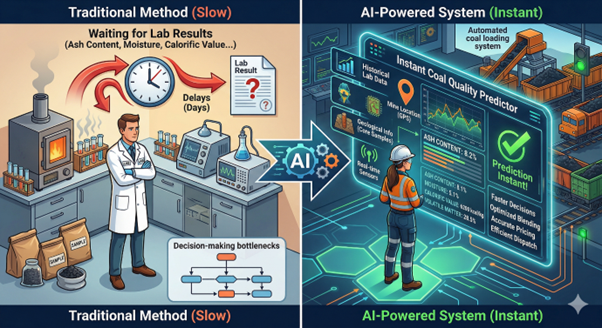
Determining the quality of coal (ash content, moisture, calorific value, etc.) usually depends on lab testing, causing delays that slow decision-making and affect blending, pricing, and dispatch. Build an AI-based system that predicts coal quality instantly using historical data, mine location, geological information, and real-time sensor inputs.
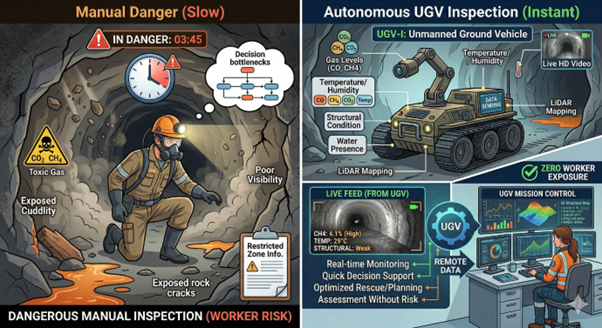
Certain underground mine areas are too dangerous to enter due to toxic gas, poor visibility, roof collapse risk, waterlogging, fire, or lack of ventilation. Develop a UGV capable of navigating narrow passages and collecting critical data — gas levels, temperature, humidity, structural condition, and live video — without exposing workers to danger.
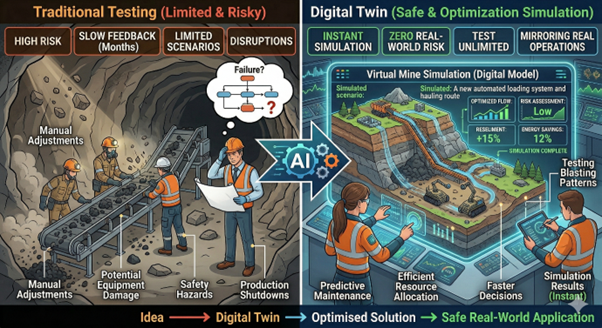
Modern mining operations are complex, dynamic, and high-risk, making it difficult to test new strategies directly in the field. Build a digital twin — a virtual replica of a mine — where engineers and planners can experiment with scenarios, optimise operations, and predict outcomes without disrupting real-world activities or compromising safety.
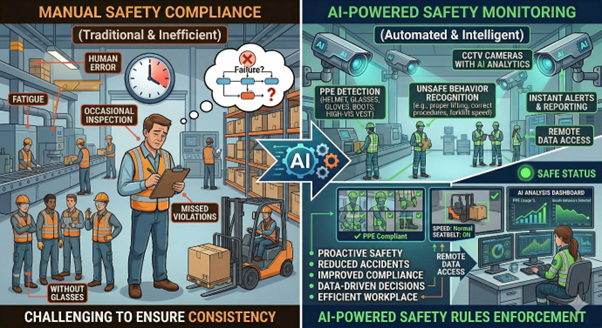
Continuous manual monitoring of PPE compliance and safe practices in mines is challenging, error-prone, and resource-intensive. Design an AI-powered system using camera feeds and computer vision to automatically detect whether workers are wearing required safety gear (helmets, gloves, vests) and adhering to defined safety protocols in real time.
All submissions are scored equally across four dimensions
Problem Understanding – Clarity in addressing the challenge and real-world relevance.
Design Innovation – Creativity, originality, and effectiveness of the concept.
Sustainability – Use of eco-friendly materials and environmental integration.
Performance – Stability, resilience, and functionality under test conditions.
Execution & Presentation – Build quality, cost-effectiveness, and clarity in communication.
In coal mining, determining the quality of coal (like ash content, moisture, calorific value, etc.) usually takes time because it depends on lab testing. This delay can slow down decision-making and affect blending, pricing, and dispatch.
Build an AI-based software system that can predict coal quality instantly using historical lab data, mine location, geological information, and real-time sensor inputs (if available). Instead of waiting for lab results every time, the system should estimate coal composition quickly and accurately, helping teams make faster decisions.
In underground mines, there are certain areas that become too dangerous or impossible for workers to enter due to reasons like toxic gas, poor visibility, roof collapse risk, waterlogging, fire, or lack of ventilation. In such situations, sending people for inspection puts lives at serious risk.
Develop an Unmanned Ground Vehicle (UGV) capable of operating within underground mines and monitoring areas where human entry is unsafe or not possible. The UGV should be able to travel through narrow and difficult mine passages while collecting important information such as gas levels, temperature, humidity, structural condition, water presence, and live video. The system should help mine operators remotely inspect hazardous zones, assess risks, and make quick decisions without exposing workers to danger.
Modern mining operations are complex, dynamic, and high-risk, making it difficult to test new strategies directly in the field. Imagine having a virtual replica of a mine — a "digital twin" — where engineers and planners can experiment with different scenarios, optimise operations, and predict outcomes without disrupting real-world activities or compromising safety.
Build a digital model that mirrors actual mining operations and helps simulate different scenarios, enabling teams to make data-driven decisions, test interventions safely, and plan operations with greater precision.
All mines operate under strict safety regulations. However, continuous manual monitoring to ensure compliance — such as wearing personal protective equipment (PPE) and following safe practices — is challenging, error-prone, and resource-intensive.
Design and develop an AI-powered system that leverages camera feeds and computer vision techniques to monitor and detect safety compliance in real time automatically. The system should be capable of identifying whether workers are wearing required safety gear (e.g., helmets, gloves, vests) and adhering to defined safety protocols.